
Patent Specification
Title of the Invention
Asynchronous Orbital Computing Architecture with Distributed Deep-Space Processing and Terrestrial Edge Caching for Low-Emission AI Synthesis
Field of the Invention
This invention relates generally to large-scale computing infrastructure. More particularly, the invention relates to a system and method for mitigating the energy, water, and environmental footprints of terrestrial artificial intelligence (AI) training. This is achieved by utilizing an integrated constellation of modular, decentralized computing satellites in high-altitude orbits to perform resource-intensive processing asynchronously, paired with localized terrestrial base stations for low-latency inference delivery.
Background of the Invention and Prior Art
Modern artificial intelligence training workflows require massive computational infrastructure. Terrestrial data centers housing thousands of high-density graphics processing units (GPUs) consume gigawatts of electricity and millions of gallons of fresh water for evaporative cooling. This operational density strains municipal power grids, contributes to localized thermal pollution, and exacerbates greenhouse gas emissions.
Prior attempts to move computing to space have suffered from fundamental design flaws. They typically attempt to replicate terrestrial configurations by grouping dense server blocks into a singular orbital structure. This approach results in catastrophic thermal failures because the vacuum of space lacks ambient air or fluid to carry away low-grade heat via conduction or convection.
Furthermore, operating computing nodes in Low Earth Orbit (LEO) introduces severe orbital decay due to upper atmospheric drag, requiring constant propellant consumption and risking space debris collisions. Conversely, operating computing nodes in Geosynchronous Earth Orbit (Orbit/Ring) introduces a round-trip radio frequency (RF) or optical transmission latency bottleneck of approximately 240 to 280 milliseconds, making real-time interactive computation unviable for end-users on Earth.
There is a critical need for an architecture that utilizes the absolute advantages of deep space—including continuous solar irradiance and an unshaded connection to the dark void for infrared photon emission—while bypassing the constraints of latency and localized thermal dissipation.
Summary of the Invention
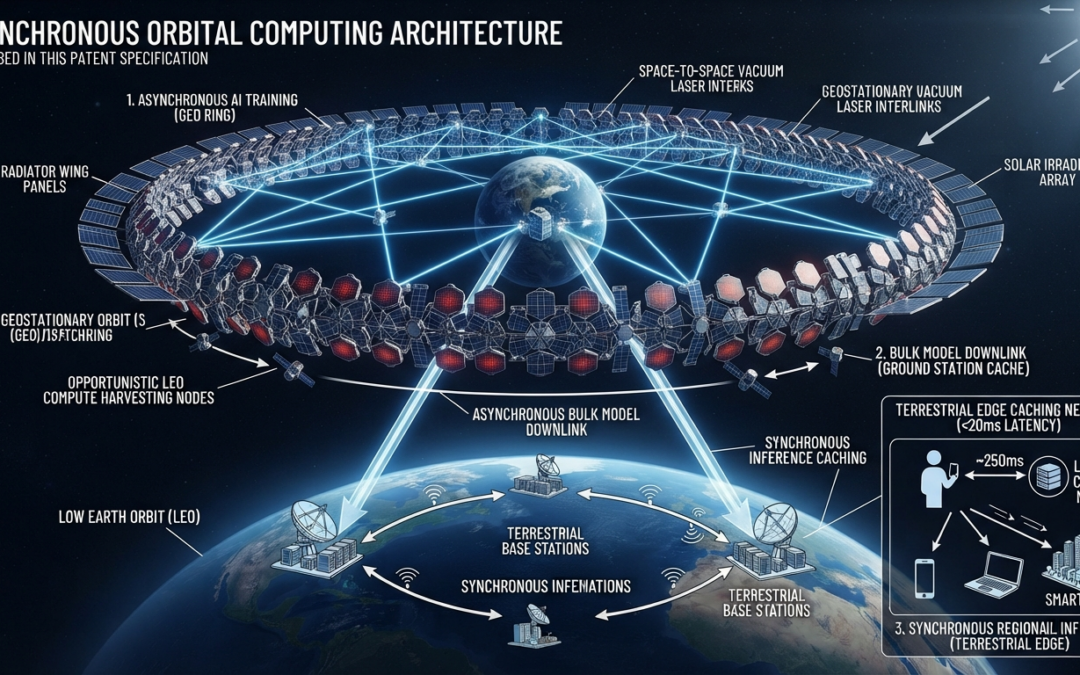
The present invention solves these problems by decoupling the computing pipeline into two mathematically separate phases: Asynchronous Training and Synchronous Inference Caching.
                                  [ DIRECT SOLAR IRRADIANCE ]
                                              │
                                              ▼
    ┌─────────────────────────── [ GEO / DISPATCH RING ] ───────────────────────────┐
    │                                                                               │
    │  • Thin-Film Modular GPU Chasses                                             │
    │  • 100% Bi-Directional Radiator Exposure                                     │
    │  • Space-to-Space Vacuum Laser Interlinks (0% Atmospheric Interference)       │
    │                                                                               │
    └───────────────────────────────────────┬───────────────────────────────────────┘
                                            │
                                            │ (Asynchronous Bulk Model Download)
                                            ▼
                                [ TERRESTRIAL BASE STATIONS ]
                                            │
                             ┌──────────────┴──────────────┐
                             ▼                             ▼
                      [ LOCAL CACHE A ]             [ LOCAL CACHE B ]
                             │                             │
                             ▼                             ▼
                     [ END USER <20ms ]            [ END USER <20ms ]
The system comprises an orbital segment positioned preferably in a high-altitude or geosynchronous orbit (GEO), arranged as a decentralized, modular constellation forming a processing ring. Each compute node within the ring is structurally optimized as a thin-film, double-sided chassis where high-performance processors are conductively mated directly to expansive structural radiator wings, providing 100% un-shaded exposure to the vacuum void for maximum thermal photon radiation.
The orbital segment performs massive machine learning calculation workloads asynchronously, operating entirely independently of human-perceived network latency. The nodes communicate internally via space-to-space vacuum optical laser interlinks, which transmit data roughly 40% faster than glass fiber-optic cables on Earth.
Upon completion of a computational epoch or model training phase, the resulting static parameter weights are transmitted down via a high-bandwidth downlink to an array of distributed Terrestrial Base Stations. These base stations cache the trained model locally, serving real-time requests (inference) to regional end-users at hyper-low latencies (<20ms), completely removing the environmental load of training from Earth’s ecosphere.
Detailed Description of the Preferred Embodiments
1. The Modular Satellite Compute Architecture
Referring to the physical structure of the space-based compute segment, each satellite is configured to maximize surface area relative to total thermal mass.
-
- The Radiator Hull: Unlike boxed terrestrial server racks, the satellite chassis is flat and elongated, featuring a high-emissivity coating (e.g., specialized metal oxides) optimized for the infrared spectrum.
- Thermal Flow: Processing units are arrayed across the internal core of the panel. Heat moves via direct metal-to-metal conduction to the outer skins of the hull. Because the satellite is oriented knife-edge relative to the Sun, one face receives continuous solar power via advanced photovoltaic layers, while the opposing faces are permanently shielded, maximizing the thermal gradient against the absolute cold of deep space to accelerate infrared photon emission.
2. High-Altitude and Geosynchronous Orbit Optimization
In the preferred embodiment, the compute constellation is deployed in a Geosynchronous Earth Orbit (GEO) ring.
-
- Elimination of Drag: At an altitude of approximately 35,786 kilometers, atmospheric drag is non-existent, completely eliminating the operational necessity for constant orbital-reboost propellants and avoiding the dense debris fields of LEO.
- Continuous Line-of-Sight: Satellites within the GEO ring maintain fixed geometric relationships with one another, establishing permanent, uninterrupted optical laser cross-links. This eliminates the packet loss and hand-off overhead associated with rapidly moving LEO constellations.
3. Radiation Tolerance via TMR Software Layering
To operate high-density, low-voltage consumer-grade GPU architectures within the harsh radiation environment of high-altitude orbits without the launch weight penalty of heavy lead or tantalum shielding, the system utilizes a Triple-Modular Redundancy (TMR) asynchronous software loop.
-
- The Method: Every mathematical tensor operation required by the machine learning algorithm is processed simultaneously across three independent, physically separated silicon matrices on the satellite.
- The Correction: A hardware-level voting gate compares the three outputs in real time. If a cosmic ray or solar proton induces a single-event upset (bit-flip) on one chip, the anomalous result is instantly discarded, and the majority consensus is committed to memory, ensuring computational integrity without physical mass penalties.
4. Terrestrial Caching and Asynchronous Synchronization
The structural workflow of data routing is explicitly designed to handle the ~250ms round-trip latency inherent to GEO distances:
-
- Step 1 (Bulk Uplink): Terrestrial datasets are compressed and uploaded via optical ground stations during periods of low atmospheric interference.
- Step 2 (The Asynchronous Run): The GEO ring processes the training data over extended cycles (days, weeks, or months). Space-to-space laser communication handles the sub-nanosecond syncing required between processing nodes.
- Step 3 (The Downlink): Once training is concluded, the static model file (the neural net weights) is sent down via bulk downlink.
- Step 4 (Local Serving): The terrestrial base stations deploy the model into memory. When an end-user on Earth submits a request, they interact strictly with the local ground-based cache, bypassing the space loop entirely for daily usage.
5. Opportunistic Off-Peak LEO Compute Harvesting
In an alternative embodiment, secondary compute nodes are integrated directly into low-altitude telecommunications satellite fleets (such as Starlink). The system includes an automated traffic-monitoring algorithm that tracks human usage waves across global time zones.
When a cluster of satellites passes over an unpopulated region or enters local nighttime hours where telecommunication demand drops to near zero, the onboard flight computer automatically routes excess solar power and system bandwidth to execute background shards of the global AI training model, turning global communication idle time into a distributed computing battery.
When a cluster of satellites passes over an unpopulated region or enters local nighttime hours where telecommunication demand drops to near zero, the onboard flight computer automatically routes excess solar power and system bandwidth to execute background shards of the global AI training model, turning global communication idle time into a distributed computing battery.
Claims
What is claimed is:
- An asynchronous computing architecture comprising:
-
- an orbital constellation comprising a plurality of decentralized computing satellites arranged in a space-to-space network;
- wherein each computing satellite comprises at least one processing unit conductively coupled to a high-emissivity structural radiator panel configured to dissipate thermal energy into a vacuum exclusively via infrared photon radiation;
- a vacuum-optimized wireless data linkage interconnecting said plurality of computing satellites; and
- a plurality of terrestrial base stations positioned on Earth, configured to receive a processed computational output from said orbital constellation via a space-to-Earth downlink, cache said computational output locally, and serve said cached computational output to a network of terrestrial end-users.
-
- The architecture of claim 1, wherein said orbital constellation is positioned in a Geosynchronous Earth Orbit (GEO) configured to maintain continuous line-of-sight laser cross-links between adjacent computing satellites.
- The architecture of claim 1, wherein the computation executed by the orbital constellation is a machine learning training protocol, and wherein the computational output received and served by the terrestrial base stations is a static file of neural network weights configured to process user inference locally.
- The architecture of claim 1, wherein each computing satellite includes a software-defined triple-modular-redundancy processing loop configured to execute identical mathematical operations simultaneously across three separate silicon cores to detect and eliminate cosmic radiation-induced bit-flips via majority-vote consensus.
- The architecture of claim 1, wherein said orbital constellation comprises auxiliary processing nodes embedded within a low-Earth-orbit telecommunications fleet, containing an automated scheduling algorithm configured to divert processing power to background machine learning workloads dynamically during regional off-peak telecommunication traffic hours.
Please get in touch with Microlinx Technologies with any questions or inquires.